Products
Plate heat exchanger
Brazed design · Gasketed design · Semi-welded design · Fully welded design · Free-flow plate heat exchanger
ETS offers plate heat exchangers as an efficient and economical alternative to conventional heat exchangers for a wide variety of applications in almost every field. The brazed plate heat exchangers are suitable for a differential pressure of up to 25 bar and temperatures from −20 °C to +185 °C. Bolted plate heat exchangers can also be designed for aggressive media with special gaskets.
Designs
Brazed, gasketed, free-flow, semi-welded, circumferentially welded and double-wall / fully welded.

Brazed design
Brazed plate heat exchangers need no gaskets and are suitable for temperatures from −20 °C to +185 °C and working pressures up to 25 bar. The high turbulence enables efficient heat transfer in a compact design. They are suitable for liquid media in industry and building services and as condensers and evaporators in refrigeration systems

Gasketed design
Gasketed plate heat exchangers are used for high heat duties, primarily for liquid media in industry, marine applications and building services. The max. working pressure is 16 bar at 160 °C.

Free-flow plate heat exchanger
Free-flow plate heat exchangers allow cooling or heating of fouling media, e.g., media containing fibers or solid particles, without deposits forming on the plates. Typical applications are the cooling or heating of orange juice, yogurt, ice cream, wort, tomato sauce, wastewater and cellulose.

Semi-welded plate heat exchangers
Semi-welded plate heat exchangers are mainly used for high-pressure applications and for aggressive media, where no gaskets and no brazing are permitted. The weld seam lies outside the gasket groove, which rules out corrosion attack.

Circumferentially welded plates
The “circumferentially welded” plate heat exchanger works like a shell-and-tube heat exchanger, except that the tubes have been replaced by more efficient plates. These are welded together into a pack using laser/TIG welding and installed in a shell. Advantages: no gaskets, safe operation, up to 250 °C and 25 bar, space-saving. The circumferentially welded plate heat exchanger is used for district heating, as a steam or oil heat exchanger, and as an evaporator and condenser.

Double-wall heat exchanger
For applications where regulations or operational reasons require an additional level of safety. Both media are separated by double plates made of stainless steel. In the very unlikely event of an internal leak, the medium escapes visibly to the outside via the safety chamber instead of mixing with the second medium.
Advantages of ETS plate heat exchangers
Higher duty with less material – the modern approach to process cooling and heating.
Thermal efficiency
Plate heat exchangers are characterized by a compact design, high thermal efficiency and flexible use. Depending on the application, they allow very small temperature differences, down to 1 kelvin, and thus particularly efficient heat transfer in counterflow.
Installation and maintenance
The low weight makes transport and on-site installation easier. The design is easy to service, giving quick access to the plates and simplifying cleaning and maintenance.
Expandable system
For gasketed plate heat exchangers, the duty can be adjusted flexibly. By adding or removing plates, the heat transfer duty can be adapted to changing requirements at any time.
Which process data determine the design
A plate heat exchanger consists of several heat transfer plates, between which the media flow in separate channels. Heat is transferred from one medium to the other via the plates.
ETS has many years of experience in the calculation and sizing of plate heat exchangers. Depending on the application, bolted, brazed or welded designs are available.
For the optimal design, we take into account the medium, pressure, temperature, fouling risk and maintenance requirements.
- Medium and compatibility: Materials, gaskets and channel geometry are individually matched to the media used and their properties.
- Pressure and temperature: Operating and design data determine the plate pack, connections and the appropriate construction type.
- Cleaning and maintenance: Whether the unit needs to be opened, expanded, or operated with particle-laden media is clarified in the technical review.

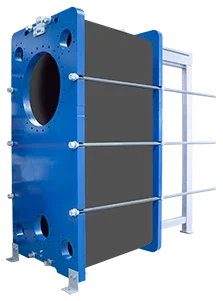
Original photograph of an ETS plate heat exchanger. The specific design is engineered for each project.
Relevant for technical sizing
- MediaComposition and fouling
- Operating dataPressure, temperature and duty
- MaterialsCorrosion and gasket concept
- Installation conditionsMaintenance access and space requirements
Technical specifications at a glance
The standard limit values for our series. Higher values available on request via special sizing.
Swipe the table sideways →
Typical fields of application for this heat exchanger type
Where plate heat exchangers are used
Plate heat exchangers enable efficient, resource-saving heat transfer in numerous industrial sectors, and especially in the food industry. They are used when media must be heated or cooled precisely and high hygiene requirements apply.
The compact arrangement of many plates creates a large heat transfer surface in a small footprint. With gasketed designs, the plates can be easily taken apart for cleaning and maintenance.
- Industry
- Marine
- Food production
- Dairies
- Heating
- District heating
- Solar technology
Downloads
Product brochure
Plate heat exchanger
Frequently asked questions & concerns
Useful information on the sizing, installation and maintenance of plate heat exchangers.
How does ETS support the selection of the right plate heat exchanger?
Plate heat exchangers are among our specialties. With our broad range, we offer solutions for nearly every application. Fill out our inquiry form and arrange a no-obligation consultation with our experts.
Which designs and production volumes does ETS supply?
Customer-specific designs as well as large and small production runs can be delivered at short notice.
How is the optimal size of the heat exchanger determined?
Using specially developed calculation programs, our engineers size the heat exchanger precisely and efficiently. The calculation is based on your operating parameters, such as mass flow rates, inlet and outlet temperatures, permissible pressure loss and media properties.
Can aggressive or abrasive liquids be handled?
Special gaskets and materials such as titanium, titanium-palladium or Hastelloy allow use even with aggressive media. Free-flow geometries are also suitable for solids-laden media such as slurries and for demanding acids and alkaline solutions.
What about gasket wear and service?
With gasketed plate heat exchangers, individual gaskets can be replaced easily on site. High-quality gaskets ensure a long service life. For applications without gaskets, brazed plate heat exchangers or circumferentially welded versions are available.
Start your sizing with our engineers
Send us your most important operating data: mass flow rates, inlet and outlet temperatures, the maximum permissible pressure loss and the properties of the media used. On this basis, our engineers size the optimal plate configuration and prepare a suitable quote for you.
Fill out our contact form – our team will get back to you as quickly as possible. If you have questions, we are also happy to advise you personally by phone.