
Products
Sterile shell-and-tube heat exchanger

WFI / product cooler/heater · CIP-solution heat exchanger · Exhaust air cooler / condenser · Exhaust air heater
For sensitive pharmaceutical media, heat exchangers with a double tube sheet (DTS) and hygienic geometry provide safe and controlled media separation. Each design is matched to the customer’s specific requirements. On the product-contact side, a surface finish down to Ra ≤ 0.4 µm is possible.
Hygienic design features
Pharma heat exchangers from ETS AG are designed in Tübach and meet high requirements for hygiene, purity and process reliability. The designs are aligned with the relevant FDA and cGMP requirements. Our shell-and-tube heat exchangers are suitable for pharmaceutical applications in which liquids or gases must be cooled or heated reliably. Hygienic designs minimize the risk of contamination by bacteria and other microorganisms.
Double tube sheet (DTS)
A double tube sheet ensures reliable separation of the primary and secondary media. In the event of a leak, the escaping medium can be discharged unpressurized and detected at an early stage.
Completely drainable
The special arrangement of the topmost and bottommost tubes allows the tube side to be completely drained and vented. The shell side can also be completely drained and vented via suitable connections or bores in the inner tube sheets.
Ra ≤ 0.4 µm finish
All product-contact surfaces are mechanically ground and can be electropolished if required. The heat exchanger tubes are seamless. The smooth, seamless tube surfaces minimize the risk of microbial and particle adhesion and support hygienic process operation.
Insulation cladding
The insulation is clad with fully welded, matte-ground stainless steel sheet. The robust design is durable, withstands cleaning and meets high hygiene requirements.
Safe design for the highest hygiene requirements
The heat exchanger can be sterilized and therefore meets high requirements for purity and hygiene. Expansion joints can be used for additional operational safety. The design is specifically tailored to thermal loads and thermal expansion.
Connections, dimensions, surfaces and documentation are defined individually based on the respective process data.
- Design free of dead space No stagnant areas in the product flow. This enables reliable cleaning, rinsing and sterilization and reduces the risk of deposits, microbial growth and cross-contamination – especially in hygienic and pharmaceutical applications.
Technical data
Swipe the table sideways →
Typical fields of application for this heat exchanger type
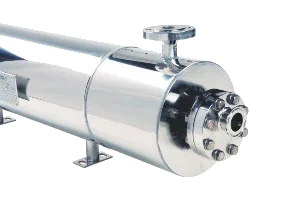
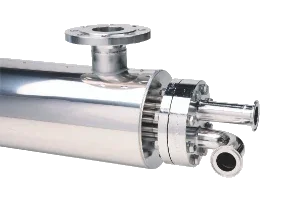
Single- and multi-pass designs
Depending on flow velocity and temperature profile, single-pass or multi-pass designs are available.
Design, number of passes, and connections are sized from the process conditions.
Sizes shown (new tab)1-pass design
Multi-pass design (max. 4-pass design)
Applications in pharma and biochemistry
Sterile shell-and-tube heat exchangers are used in the pharmaceutical industry and biochemistry, especially in applications with high hygiene requirements. They are suitable for processes in which the product is routed through the heat exchanger and the system is subsequently cleaned and sterilized using the CIP/SIP process.
Thanks to standardized components available from stock, the heat exchangers can be supplied economically and at short notice.
- WFI cooler
- Product cooler and heater
- CIP-solution heat exchanger
- Exhaust air heater
- Exhaust air cooler and condenser
Testing and documentation
Design and acceptance are carried out in accordance with PED (Pressure Equipment Directive). The scope of documentation is defined on a project-specific basis and includes material certificates, weld documentation and test records, among other things.
Ferrite content ≤ 3%
Documented ferrite content measurement
Ra ≤ 0.4 µm
A surface roughness of Ra ≤ 0.4 µm minimizes deposits and microbial adhesion and enables reliable cleaning and sterilization.
Material certificates
Tested material quality and complete traceability of the materials used.
Downloads
Product brochure
Sterile shell-and-tube heat exchanger
Frequently asked validation questions
Answers on documentation, drainability and design.
Which test and material documents are supplied?
The scope of documentation is agreed per order. Typical items are 3.1 material test certificates, delta-ferrite verification of the weld seams, roughness records of the product-contact surfaces, weld documentation, and records of the pressure test, dye penetrant testing (PT) and X-ray testing. The O-ring seal is supplied with an FDA or USP Class VI certificate. This does not imply an FDA certificate for the entire unit.
How is complete drainability physically ensured?
For horizontal installation, the heat exchanger must be mounted with a slight downward slope. Positioning the topmost and bottommost tubes exactly at the casing boundaries (tangential outlet) ensures that residual liquid drains completely from the product side. No residues remain.
Can the unit be designed to ASME?
Yes, tube geometry, tube wall thicknesses, flange designs (Tri-Clamp / ASME) and surface finish can be designed to the requirements of the ASME guidelines for piping components in the biopharma sector.
Secure your ultrapure water and pharma processes
Send us your process parameters for the calculation of your WFI or product cooler. Our engineers take the agreed cGMP requirements into account and size the heat exchanger individually for your application.
Fill out our contact form – our team will get back to you as quickly as possible. If you have questions, we are also happy to advise you personally by phone.