Products
Finned heat exchanger


Air-cooled liquid coolers · Air heaters · Heat recovery coils · Forced-air coolers · Compressed gas coolers · Oil coolers · Generator coolers · Evaporators · Condensers
Finned heat exchangers from ETS AG are used primarily for heating and cooling liquids with gases or vice versa. Heat transfer can take place with various media such as water, brine, saturated steam, hydraulic or lubricating oil, thermal oil, as well as condensing or evaporating refrigerants. Thanks to their finned design, finned heat exchangers can accommodate a large active outer surface in a small volume. Our series cover a range of heat transfer surfaces from 0.1 to 8,000 m².
Types
Five types: FLNB, LK, LBD, LBF and KKG.

Type FLNB
The FLNB series is developed and manufactured in line with the latest state of the art. It stands for efficient and reliable oil cooling. The oil coolers consist of aluminum elements with a casing or hood and fan. The standard series comprises twelve types with a maximum cooling duty of 150 kW. The FLNB is suitable for recooling hydraulic, lubricating and gear oil and offers a reliable solution for a wide range of industrial applications.

Type LK
The recoolers of the LK series reliably remove excess heat to the ambient air. They are suitable for liquid circuits with water or brine and can also be used as condensers. The standard series comprises 24 types with heat transfer surfaces up to 1,200 m². Depending on the application, the units are available as a wall or ceiling model. Backed by over 20 years of practical experience, we advise you on selecting the right recooler for your application.

Type LBD
This type is used for heating process air or process gas through condensation of saturated steam or superheated steam. Depending on requirements, various materials such as galvanized or stainless steel are available. Applications with high operating pressures up to 1,000 bar with corresponding test certificates are also possible. ETS AG offers various design types here, matched to the gas used. Of course, we are also happy to advise you individually on request.

Type LBF
A universally applicable finned heat exchanger used for heating and cooling gases and liquids. Various material combinations from copper, copper-nickel, brass, aluminum through to a fully stainless design for high corrosion resistance are possible. The individual elements can have an overall length of up to 8,000 mm. We are happy to discuss the ideal overall length of the materials and their properties with you during the planning phase.

Type KKG
High-pressure coolers are used in the compression of natural gas and industrial gases. Discharge pressures of up to 1,000 bar can occur here. The KKG series is specially designed for recooling compressed gases. It enables reliable and safe cooling, even at high operating pressures.
Advantages of ETS finned heat exchangers
Efficient transfer of thermal energy between gases and liquids.
Maximized outer surface
Press-fitted fins make it possible to fit extremely large heat transfer surfaces into a compact volume.
Pressures up to 1,000 bar
Special designs (type KKG) ensure reliable gas cooling even at extreme compressor discharge pressures.
Materials
Tubes: copper, copper-nickel, steel, stainless steel. Fins: aluminum, copper, stainless steel. Casing: aluminum, steel, galvanized steel, stainless steel.
Thermal expansion compensation
Special design variants make it possible to accommodate even large thermal expansions of the tubes safely and reliably.
Design and function
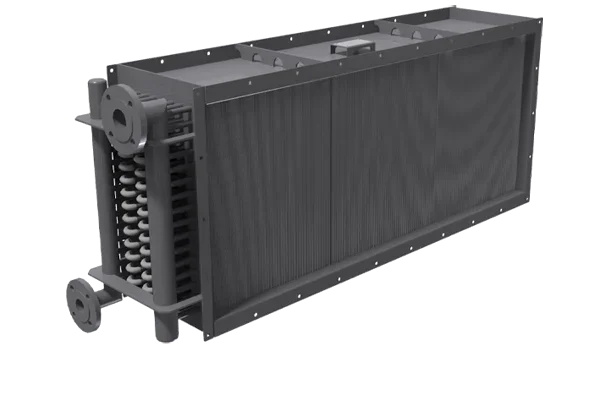
Finned heat exchangers essentially consist of core tubes with slid-on or press-fitted fins, a sturdy casing, and several collectors or headers. The flow arrangement is adjusted individually according to the required operating data. Special design variants make it possible to accommodate even large thermal expansions of the tubes without difficulty. For applications with demanding corrosion requirements and high operating pressures (up to 800 bar), special tube/fin material combinations are available.
- Core tubes with fins The fins are slid or press-fitted onto the core tubes.
- Casing Aluminum, steel, galvanized steel or stainless steel.
- Collectors or headers The flow arrangement is adjusted individually according to the required operating data.
Sizing based on process data
The specific design is sized from the process data.
Technical data: finned heat exchanger
The limit values and materials of our finned series.
Swipe the table sideways →
Typical fields of application for this heat exchanger type
What finned heat exchangers are built for
Heat transfer takes place with water, brine, saturated steam, hydraulic or lubricating oil, thermal oil, and with condensing or evaporating refrigerants. Cooling and heating liquids or gases is part of everyday work in many industrial operations. The units are especially popular in power plant engineering, in the machinery industry, and in the paper industry. In these fields, various work processes are very closely interlinked with the cooling or heating of different liquids. In addition, we offer excellent finned heat exchangers that can be used in the chemical industry or in process engineering.
Available as a unit
- Air-cooled liquid coolers
- Air heaters
- Heat recovery coils
- Forced-air coolers
- Compressed gas coolers
- Oil coolers
- Generator coolers
- Evaporators
- Condensers
Used in
Power plant engineering · Machinery industry · Paper industry · Chemical industry · Process engineering · Environmental technology · Heating and ventilation technology
Downloads
Product brochure
Finned heat exchanger
Frequently asked questions about finned construction
Key criteria for thermodynamic calculation and cleaning.
How does ETS support the selection of a finned heat exchanger?
We advise you personally on selecting the right finned heat exchanger. Our extensive range offers solutions for nearly every industry – complemented by custom-built units where standard solutions are not sufficient. Use our inquiry form in the downloads area or contact us directly. We look forward to your inquiry.
How is permanent mechanical contact between tube and fin achieved?
Once the fin strip has been fitted onto the core tubes, the tubes are expanded hydraulically or mechanically in their inside diameter. As a result, the tube walls are permanently pressed against the fin collars, forming an interference fit. This creates a stable mechanical contact that ensures optimum heat transfer between tube and fin.
Which sizing data are required for a calculation?
For precise sizing, we need the inlet and outlet temperatures of both media, the respective flow rates (volumetric flow rate of the air and mass flow rate of the fluid), and information on which medium is routed on the tube side. In addition, details of the available installation space and the maximum permissible pressure losses on both sides are required. Based on these operating data, the fluid routing is individually designed and optimally adapted to the respective requirements.
For what purposes are finned heat exchangers used as air heaters?
Finned heat exchangers used as air heaters are employed wherever air or process gas needs to be heated in a controlled way. Typical applications are found in industrial buildings and warehouses, open-plan offices and numerous industrial processes. In this process, the heat of a heating medium – for example hot water, thermal oil or steam – is efficiently transferred via the tubes and fins to the air flowing past. For steam applications, our LBD is used in particular. It is specially designed for transferring heat from condensing steam to air or process gas. Our finned heat exchangers are used in the chemical industry, environmental technology, the paper industry, power plant engineering and mechanical engineering, among others. We will gladly advise you on selecting and sizing the right air heater for your application.
Size your finned coil precisely
For precise sizing, we need the key operating data: the inlet and outlet temperatures of both media, the flow rates (volumetric flow rate of the air, mass flow rate of the fluid), the available installation space and the maximum permissible pressure losses on both sides.
Do you have questions or would you like to discuss your requirements directly? Feel free to call us. Our knowledgeable team members will advise you personally and work with you to find the right solution.